


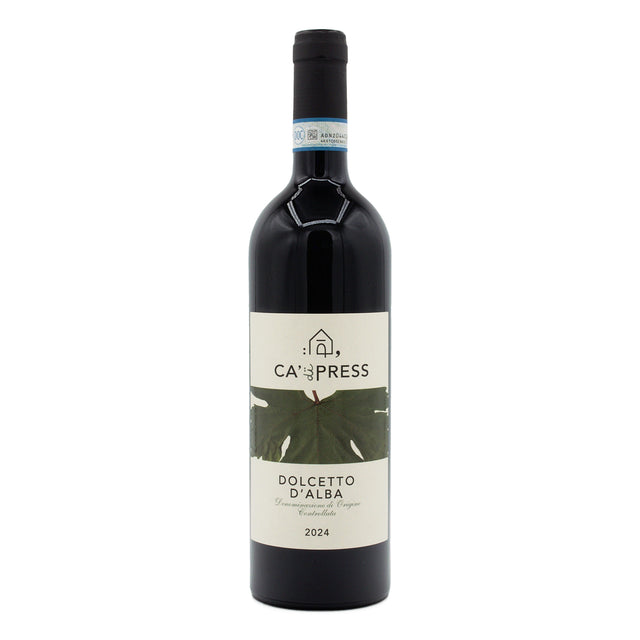
Ca' di Press Dolcetto d'Alba 2024
We have 6 in stock (Inventory is live and accurate)
The Land
In much of the Langhe, Dolcetto gets the leftover slopes, the ones too cool or poorly exposed for Nebbiolo. At Ca' di Press it grows in old-vine plots in Perno, the hamlet on Monforte d'Alba's eastern side that also gives the family its Barolo. The soil is sandy clay, and the Dolcetto rows face both southeast and northeast. That split matters for an early-ripening grape: the southeast-facing vines bring ripeness and color, while the northeast-facing rows stay cooler and hold onto acidity. Clay gives the wine its dark fruit and plush middle; sand keeps the tannin soft and the aromatics clear. The result is a Dolcetto d'Alba red wine with more depth than the grape's everyday reputation would lead anyone to expect.
The Wine
Ca' di Press Dolcetto d'Alba 2024 is 100% Dolcetto, destemmed but not crushed, so whole berries go into stainless steel tanks for a spontaneous fermentation of roughly 10 to 15 days. It then spends six months in steel and two months in bottle before release, with no wood at all. Production is tiny: about 2,000 bottles and 100 magnums. Expect an inky color, black cherry, blackberry, and violet with a bitter-almond edge, a silky texture, and a lifted, floral finish. 2024 was a year that ran on rain, with frequent storms from late May through June and a Dolcetto harvest slowed by weather in mid-September. The family pulled extra leaves so the clusters could dry after heavy rain and picked ahead of the largest storms. Expect moderate alcohol and fresh acidity from the wet season.
The People
Ca' di Press is Piedmontese dialect, a nod to the family name, and the story begins in the early 1900s, when the grandparents owned vineyard land in both La Morra and Monforte. For generations they sold grapes. Bruno spent most of his career overseeing the 7.5-hectare estate, and it is his daughters, Alice and Cristina, who turned the grower into a winery, starting with the 2018 vintage. The Dolcetto shows how they work: decisions made in the vineyard first, like opening the canopy in a wet year or adding shade in a dry one, and a cellar kept simple so the site speaks. They take their cues from traditional Barolo houses, and even their everyday red is made with the same care.
Food Pairing
Dolcetto is the Piedmontese table wine, so cook like it. Bagna cauda, the warm anchovy and garlic dip, with raw peppers, fennel, and cardoons, is the classic; the soft tannin never clashes with the anchovy and the fruit rounds the salt. Veal and pork meatballs braised in tomato sauce suit the dark fruit and low tannin. A plate of salame, prosciutto, and grissini works for the same reason, and a frittata with herbs and Toma makes a good Sunday lunch. This is the red to keep on hand for the nights when dinner is simple and the wine still has to be good.
We ship wine to most states with a $100 minimum order for shipping. We don't ship spirits nor beer.
Weather shipping advisory: Orders placed during times of extreme heat or extreme cold will be held for no charge until more favorable weather returns.
Piedmont, framed by the Alps in northwestern Italy, is a land of rolling hills and carefully cultivated vineyards. The continental climate, with its cold winters and warm summers, creates prime conditions for the Nebbiolo grape, which dominates much of the region's red wine production. The Langhe area is home to Barolo and Barbaresco, structured red wines known for their complex aromas, firm tannins, and aging potential. While Nebbiolo is the dominant grape of Piedmont, the region also makes interesting white wines like those from Arneis and Timorasso. Alto Piemonte is a separate region in the north with its own distinctive expressions of Nebbiolo, alongside other red grape varietals.
Italy - Piedmont


Dolcetto is a black grape variety native to the Piedmont region in northwest Italy, cherished for its ability to produce soft, fruit-forward red wines with relatively low acidity and a pleasing bitter finish. Known for its early ripening, Dolcetto yields wines that are typically deep in color, offering aromas of black cherry and licorice, making them highly approachable in their youth. The grape is most commonly associated with wines from Dogliani, Alba, and Asti, where the varietal's characteristics are celebrated in their purest form. While not as prestigious as Nebbiolo-based wines like Barolo and Barbaresco, Dolcetto holds a beloved place in Piedmontese wine culture for its straightforward, deliciously fruity profile and its versatility with food.
